Learn the complete NCA registration requirements in Kenya, including categories, fees, documents, and step-by-step process. A 2026 updated guide for contractors and developers to register with the National Construction Authority quickly and legally.
Introduction
If you’re planning to work in Kenya’s construction industry, understanding NCA registration requirements in Kenya is not optional—it’s essential. The National Construction Authority (NCA) is the government body responsible for regulating and overseeing construction activities across the country. NCA registration is the process through which contractors and construction professionals are officially licensed to operate legally in Kenya.
This registration is mandatory under Kenyan law, and failure to comply can lead to serious consequences, including fines, project shutdowns, or even blacklisting from future opportunities. Whether you’re an individual contractor, a construction company, a developer, or a subcontractor, you are required to register with the NCA before undertaking any construction project.
In today’s competitive and regulated construction environment, being NCA registered is more than just a legal requirement—it’s a mark of credibility and professionalism that can open doors to bigger and more profitable projects.
In this comprehensive guide, we’ll break down the NCA registration requirements in Kenya step by step, including categories, documents needed, fees, and the application process. By the end, you’ll have a clear roadmap to successfully register and stay compliant.
What is NCA and Its Role in Kenya
The National Construction Authority (NCA) is a government body established to regulate, streamline, and develop Kenya’s construction industry. It was created under the NCA Act No. 41 of 2011, which provides the legal framework for overseeing all construction activities and ensuring that industry standards are upheld across the country.
The NCA plays a critical role in bringing order and professionalism to a sector that is vital to Kenya’s economic growth. One of its primary responsibilities is regulating contractors by registering and classifying them into different categories based on their capacity and expertise. This ensures that only qualified contractors handle projects appropriate to their skill level.
Additionally, the Authority is tasked with ensuring quality construction by enforcing compliance with approved building standards and codes. This helps reduce cases of poor workmanship, structural failures, and unsafe buildings. The NCA also promotes safety standards on construction sites, protecting both workers and the public from accidents and hazards.
Beyond regulation, NCA registration serves as a safeguard for both clients and contractors. For clients, it guarantees that they are hiring vetted and qualified professionals. For contractors, it enhances credibility, builds trust, and provides access to larger projects, including government tenders. In essence, the NCA helps create a safer, more reliable, and more professional construction industry in Kenya.

Who Needs NCA Registration in Kenya?
NCA registration is a legal requirement for anyone involved in construction activities in Kenya. According to the National Construction Authority, all key players in the construction value chain must be registered before undertaking any project.
This includes contractors, both local and foreign, who are directly responsible for executing construction works. Foreign contractors are typically required to register for specific projects and may need to partner with local firms. Subcontractors—those handling specialized tasks such as electrical, plumbing, or finishing works—must also be registered to ensure compliance with industry standards.
In addition, construction companies and firms offering building and civil engineering services are required to obtain NCA certification. Even individual skilled workers, including site supervisors and foremen, may need accreditation under NCA guidelines, especially for formal projects.
Failure to register with the NCA comes with serious consequences. These include hefty fines, which can significantly impact your business finances, as well as project shutdowns, where ongoing construction is halted until compliance is met. In more severe cases, offenders may face legal penalties, including prosecution or disqualification from future projects.
Ultimately, NCA registration is not just about compliance—it ensures accountability, professionalism, and trust in Kenya’s construction industry.
Categories of NCA Registration (NCA1 – NCA8)
One of the most important aspects of understanding NCA registration requirements in Kenya is knowing the different contractor categories. The National Construction Authority classifies contractors into eight categories—NCA1 to NCA8—based on their technical capacity, financial strength, and experience. These categories determine the size and value of projects a contractor is allowed to handle.
Breakdown of NCA Categories
- NCA1 – Large Contractors
These are top-tier contractors with the highest level of experience, equipment, and financial capability. They can handle large-scale projects such as highways, high-rise buildings, and major infrastructure works with no upper project value limit. - NCA2 – NCA3 (Medium-Large Contractors)
Contractors in this range are well-established and capable of handling substantial construction projects, though slightly below the scale of NCA1. They often undertake commercial buildings, apartments, and medium-to-large infrastructure works. - NCA4 – NCA6 (Medium-Small Contractors)
These contractors typically handle mid-sized projects such as residential developments, small commercial buildings, and renovations. They are suitable for developers working with moderate budgets. - NCA7 – NCA8 (Small Contractors)
This category is ideal for small-scale builders and fundis handling minor works like single residential houses, repairs, and small extensions. NCA8 represents the lowest entry level, often for startups or individual contractors.

Category vs Project Value Limits
| NCA Category | Project Value Limit (Approx.) |
| NCA1 | Unlimited |
| NCA2 | Up to KSh 500 million |
| NCA3 | Up to KSh 300 million |
| NCA4 | Up to KSh 200 million |
| NCA5 | Up to KSh 100 million |
| NCA6 | Up to KSh 50 million |
| NCA7 | Up to KSh 20 million |
| NCA8 | Up to KSh 5 million |
Choosing the right category is crucial. Applying for a higher category without meeting the requirements can lead to rejection, while choosing too low a category may limit your growth opportunities.
Detailed NCA Registration Requirements in Kenya (Core Section)
Understanding the exact NCA registration requirements in Kenya is crucial for a successful application. The National Construction Authority evaluates applicants based on legal, technical, and financial capacity—not just documentation. Below is a detailed breakdown, including why each requirement matters.
General Requirements
To begin with, every applicant must provide basic legal documentation:
- Business Registration Certificate – Confirms that your business is legally recognized in Kenya. Without this, your application cannot proceed.
- KRA PIN Certificate – Links your business to the tax system, proving you are a registered taxpayer.
- Tax Compliance Certificate – Demonstrates that you are up to date with tax obligations, which is critical for credibility and eligibility for government projects.
- CR12 (for companies) – Shows company directors and shareholders, ensuring transparency and accountability in ownership.
Technical Requirements
The NCA places strong emphasis on technical competence:
- Qualified Technical Staff – You must have engineers, supervisors, or foremen with relevant qualifications.
- Academic/Professional Certificates – Proof of training in construction-related fields such as civil engineering or building technology.
- Work Experience Records – Evidence of past projects handled, showing your capability and reliability.
Financial Requirements
Applicants must demonstrate financial stability:
- Bank Statements – Typically for the last 6–12 months, showing consistent financial activity.
- Proof of Financial Capability – May include audited accounts or asset ownership.
Additional Requirements
Other supporting documents include:
- Equipment Ownership or Lease Proof – Confirms you have access to necessary construction tools and machinery.
- Office Location Details – A physical address establishes that your business is operational and traceable.
By understanding not just what is required but why, you significantly increase your chances of approval and position yourself as a credible contractor in Kenya’s construction industry.
Step-by-Step NCA Registration Process
Applying for NCA registration in Kenya is a structured online process managed by the National Construction Authority. Following the correct steps—and avoiding common mistakes—can significantly speed up your approval.
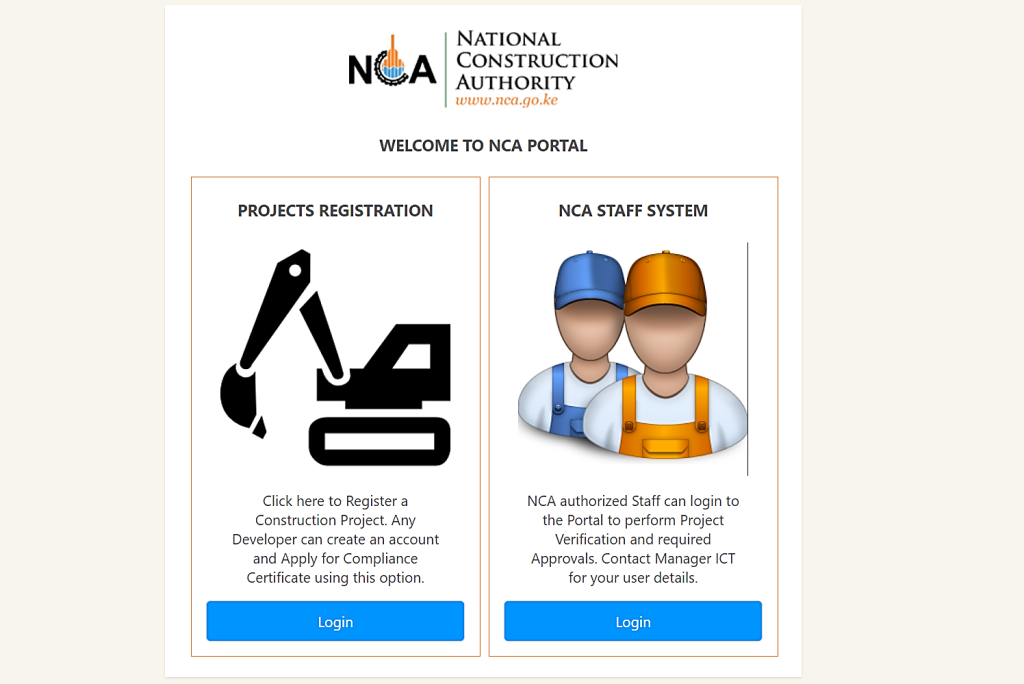
Step 1: Create an Account on the NCA Portal
Start by registering on the official NCA online portal. You’ll provide basic details such as your business name, email address, and contact information. This account will be used to track your application status.
Step 2: Fill in the Application Form
Once logged in, complete the contractor registration form. This includes business details, category selection (NCA1–NCA8), and information about your technical staff and past projects.
Step 3: Upload Required Documents
Upload all necessary documents, including business registration certificates, tax compliance, technical staff credentials, and financial records.
Step 4: Pay Registration Fees
After submitting your application, you’ll be required to pay the applicable registration fees based on your chosen category. Payment is typically done via bank deposit or mobile money options provided on the portal.
Step 5: Application Review
The NCA reviews your submission to verify compliance with all requirements. This may involve background checks and validation of your documents.
Step 6: Approval and Certificate Issuance
Once approved, you’ll receive your NCA certificate and registration number. You are now legally authorized to undertake construction projects within your approved category.
Common Mistakes to Avoid
- Submitting incomplete documentation
- Choosing the wrong NCA category
- Uploading uncertified or unclear documents
- Ignoring tax compliance requirements
By following this step-by-step process carefully, you can avoid delays and secure your NCA registration smoothly and efficiently.
NCA Registration Fees in Kenya (2026 Updated)
Understanding the cost of NCA registration in Kenya is essential for proper planning, especially since fees vary depending on the contractor category and type of application. According to the National Construction Authority fee schedule, there are three main cost components: application fees, registration fees, and annual renewal fees.
Fee Structure by Category
NCA registration fees are based on contractor class (NCA1–NCA8). For 2026, the approximate ranges are:
- NCA1 (Large contractors): KSh 100,000
- NCA2: KSh 75,000
- NCA3: KSh 50,000
- NCA4: KSh 25,000
- NCA5: KSh 20,000
- NCA6: KSh 15,000
- NCA7: KSh 10,000
- NCA8 (Small contractors): KSh 5,000
In addition, all applicants pay a standard application fee of about KSh 5,000 regardless of category. (National Construction Authority)
Application Fees vs Annual Renewal Fees
- Application Fees: One-time cost paid when submitting a new registration or upgrading a category (typically KSh 5,000). (National Construction Authority)
- Annual Renewal Fees: Paid yearly to maintain your license, ranging from KSh 2,500 (NCA8) to KSh 30,000 (NCA1). (National Construction Authority)
Failure to renew on time attracts penalty charges, which can be significantly higher than standard renewal fees.
Estimated Total Cost & Hidden Costs
While the official fees may seem straightforward, the actual cost of registration is often higher due to:
- Consultant fees (if you hire someone to handle the process)
- Document preparation costs (certification, printing, scanning)
- Financial audits (for higher NCA categories)
- Transport and administrative expenses
Key insight: Depending on your category, the total cost can range from KSh 10,000 to over KSh 150,000 when all expenses are considered.
Planning for both official and hidden costs ensures a smooth registration process without unexpected financial strain.
How Long Does NCA Registration Take?
The time required to complete NCA registration in Kenya typically ranges between 7 to 30 days, depending on the completeness of your application and the review process by the National Construction Authority. Applicants who submit all required documents correctly and meet the criteria for their chosen category often experience faster approvals.
However, several factors can affect the processing timeline. One of the most common causes of delay is incomplete or incorrect documentation, such as missing certificates, unclear scans, or inconsistencies in submitted information. These issues may require revisions or resubmission, extending the approval period.
Another key factor is the NCA category applied for. Higher categories like NCA1–NCA3 typically undergo more thorough evaluation due to the scale of projects involved, which may take longer compared to lower categories such as NCA7 or NCA8.
NCA License Renewal Requirements
Maintaining an active license with the National Construction Authority requires annual renewal, which is mandatory for all registered contractors in Kenya. Renewal ensures that your business remains compliant with current regulations and continues to operate legally within your approved NCA category.
To successfully renew your NCA license, you’ll need to submit updated documentation, including:
- Valid Tax Compliance Certificate – Confirms that your business is up to date with tax obligations.
- Updated Company Details – This may include changes in directors, contact information, physical address, or technical staff.
In some cases, you may also be required to confirm continued access to equipment or provide updated financial information, especially for higher contractor categories.
Common Challenges When Applying for NCA Registration
While applying for registration with the National Construction Authority is straightforward in theory, many applicants face delays and rejections due to avoidable challenges.
One of the most common issues is incomplete documentation. Applicants often forget key papers such as CR12, tax compliance certificates, or properly certified copies.
Solution: Always use a checklist and verify all documents before submission.
Another challenge is lack of qualified technical personnel. Some contractors apply without meeting the minimum staffing requirements for their category.
Solution: Ensure you hire or partner with qualified engineers, supervisors, or technicians before applying.
Financial proof issues are also a major setback, especially for mid and high-level categories. Weak or inconsistent bank statements may raise concerns about project capability.
Solution: Maintain clear, consistent financial records and consider audited statements where required.
Lastly, many applicants experience system or portal delays, especially during peak application periods. This can slow down submissions or document uploads.
Solution: Apply early, avoid last-minute submissions, and ensure stable internet when uploading documents.
By addressing these challenges early, applicants can significantly improve their chances of smooth and timely approval without unnecessary setbacks.
Benefits of NCA Registration
Being registered with the National Construction Authority is more than just a legal requirement—it is a powerful advantage that directly impacts your growth, credibility, and access to opportunities in Kenya’s construction industry.
First, legal compliance ensures that your business operates within the law. This protects you from fines, project shutdowns, and legal disputes that often arise when unregistered contractors attempt to work illegally.
Second, NCA registration gives you access to bigger and more profitable projects. Many high-value private developments and government projects strictly require contractors to be NCA-certified, meaning registration opens doors that are otherwise closed.
Third, it significantly boosts your credibility and trustworthiness. Clients are more likely to hire contractors who are officially recognized, reducing concerns about poor workmanship or project abandonment.
Finally, NCA registration is essential for eligibility in government tenders. Without it, you cannot bid for public construction projects, which are often the most stable and well-paying opportunities in the industry.
In short, NCA registration is not just paperwork—it is a gateway to growth, professionalism, and long-term success in Kenya’s construction sector. Contractors who register position themselves ahead of competitors and build stronger, more sustainable businesses.
Tips to Get Approved Faster
Getting approved quickly for NCA registration with the National Construction Authority depends largely on how well you prepare your application before submission.
First, hire qualified professionals such as engineers, supervisors, or technicians who meet the minimum requirements for your chosen category. Incomplete technical staffing is one of the main reasons applications are delayed or rejected.
Second, ensure that all documents are properly certified and up to date. This includes business registration papers, tax compliance certificates, and academic qualifications. Uncertified or unclear documents often lead to unnecessary delays.
Third, always apply for the correct NCA category (NCA1–NCA8) based on your financial and technical capacity. Applying for a category beyond your qualification level can result in rejection or prolonged review.
Finally, consider working with experienced consultants who understand the application process and requirements. They can help you avoid common mistakes and speed up approval.
Proper preparation is the key to faster NCA approval and smoother entry into Kenya’s construction industry.
NCA Registration for Foreign Contractors
Foreign contractors who wish to operate in Kenya must also comply with the requirements set by the National Construction Authority. However, their registration process includes additional conditions compared to local contractors.
One key requirement is a valid work permit, which authorizes foreign professionals to legally work in Kenya. Without this, registration cannot be approved. In many cases, foreign contractors are also encouraged—or required—to enter into joint ventures with local firms, ensuring knowledge transfer and compliance with local industry regulations.
Foreign entities may not always receive permanent registration. Instead, they are often granted temporary or project-based registration, which is limited to the duration and scope of a specific construction project. This ensures that foreign contractors operate under strict supervision and within defined legal boundaries.
Conclusion
Understanding NCA registration requirements in Kenya is essential for anyone planning to operate in the construction industry. Throughout this guide, we have broken down the key elements you need to know—from the required documents and technical qualifications, to financial proof, application steps, and contractor categories (NCA1–NCA8). We have also highlighted the importance of meeting both legal and professional standards during the registration process.
The step-by-step process shows that registration is not just a formality, but a structured evaluation of your capacity to handle construction projects safely and professionally. It is clear that compliance with the National Construction Authority is not optional—it is a legal requirement for all contractors, subcontractors, and construction firms in Kenya.
Ultimately, NCA registration plays a vital role in ensuring quality, safety, and accountability within the construction sector. It protects both clients and contractors while maintaining industry standards.
📞 CALL TO ACTION
Ready to register your NCA license in Kenya without delays or costly mistakes?
Work with professionals who understand:
✔ NCA registration requirements and categories
✔ Complete documentation preparation
✔ Fast, accurate, and compliant application process
Whether you’re a contractor, developer, or construction company, getting registered correctly is the first and most important step toward winning bigger projects, building credibility, and staying fully compliant with Kenyan construction laws.
Don’t risk rejection or unnecessary delays due to missing documents or incorrect category selection. Get expert guidance and ensure your application is handled the right way from the start.
Contact us today for professional support on NCA registration, category selection, and full construction compliance assistance in Kenya.